Meta Quest 3S Review: Still the Cheapest Good VR Headset, Now at $349.99
Meta raised the Quest 3S by $50 in April 2026, blaming memory costs. We looked at what the headset still does well, where the Fresnel lenses show their age, and who should look elsewhere.
The verdict
The Quest 3S is still the cheapest headset that does standalone VR, mixed reality and PC streaming without embarrassment. The $50 price rise hurts, and the Fresnel lenses are visibly softer than the Quest 3, but the same Snapdragon chip and huge library keep it the default first headset.
Best forFirst-time VR buyers who want the lowest sensible entry price
What we liked
- Same Snapdragon XR2 Gen 2 chip and 8GB of RAM as the pricier Quest 3
- Standalone, mixed reality and PC streaming from one headset
- Rated for up to 2.5 hours, longer than the Quest 3's 2.2 hours
- Largest VR game library of any headset at this price
What we did not
- Fresnel lenses are softer and have a smaller sweet spot than pancake optics
- The April 2026 rise to $349.99 erased much of the old value edge
- The cloth strap is basic and gets tiring in longer sessions
- 128GB fills up quickly once you install a few big games
VR headsets are the one product category where being cheap can be the whole feature. A headset that sits in a drawer teaches nobody anything, and the Quest 3S exists so that more people try one. Then Meta raised the price.
What changed on April 19
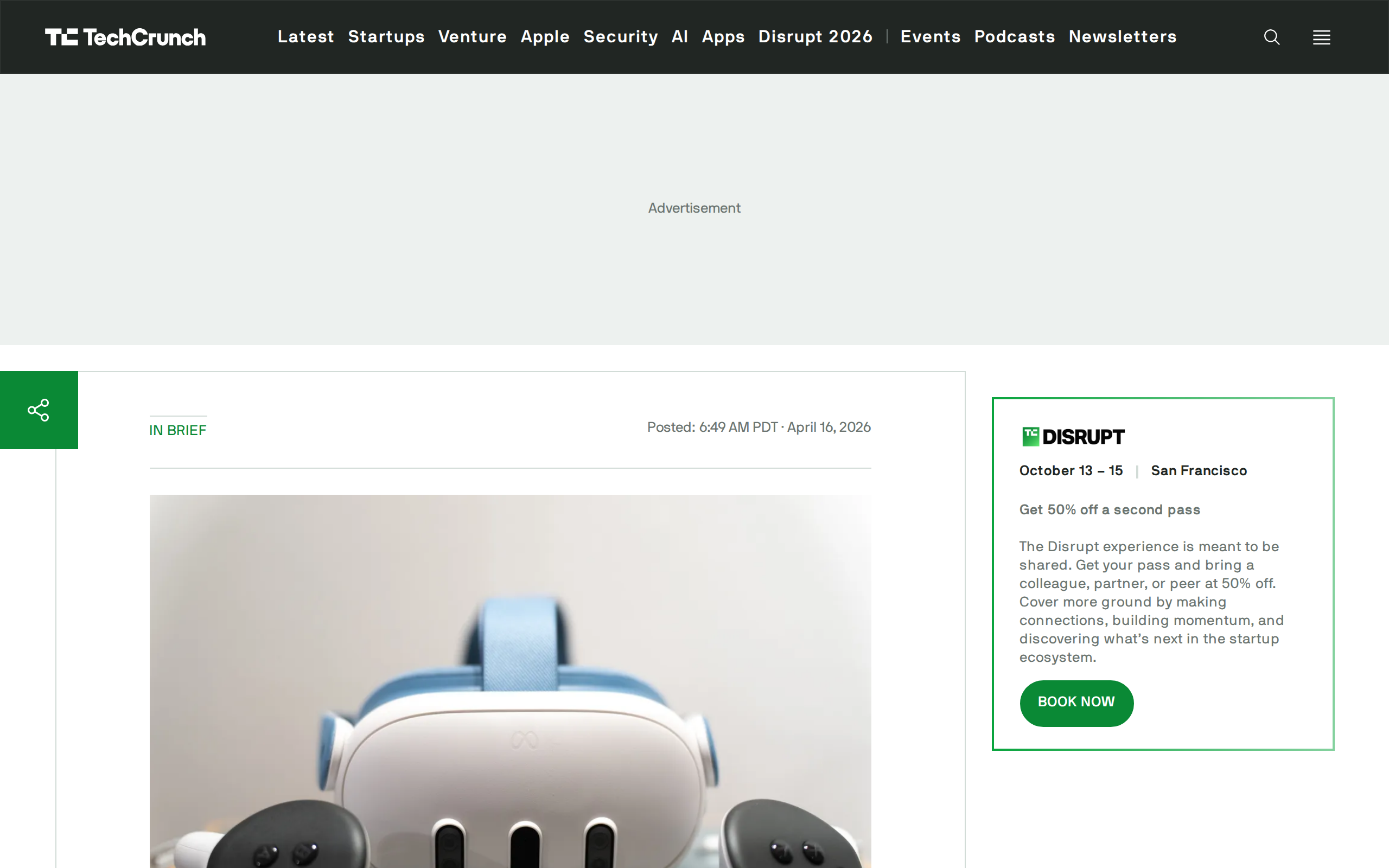
On that date Meta lifted the Quest 3S from $299.99 to $349.99 for the 128GB model, and from $399.99 to $449.99 for 256GB. Meta's explanation, reported by TechCrunch, is a global squeeze on memory chips that has hit most consumer electronics.
That is a 16.7 percent jump on the cheapest model, and it pushes the headset over the $300 line that made it an impulse buy. It is still the cheapest Meta headset by a wide margin, and for a first headset we think it remains the right answer, but it is no longer a bargain by instinct. You have to want VR now.
The chip is the same, the lenses are not
Here is the part that keeps the 3S in the conversation. It has the Snapdragon XR2 Gen 2 and 8GB of RAM, exactly what the Quest 3 uses, so games run the same on both. Android Central's comparison puts it plainly: optics are the big gap, and performance is level.
The optics are real, though. The 3S shows 1,832 x 1,920 pixels per eye through Fresnel lenses, the same panel as the Quest 2. The Quest 3 has 2,064 x 2,208 and pancake lenses, about five more pixels per degree. In text-heavy apps you can see it. In a fast shooter or a rhythm game you stop noticing within minutes.
What the old price gap meant
At launch the 3S was $200 under the Quest 3. After the rise, both headsets moved, so the sensible question is no longer "how much do I save" but "what do I give up for the saving". You give up sharpness and some optical comfort. You do not give up speed, the controllers, color passthrough or the game store.
Specs
- Chipset
- Qualcomm Snapdragon XR2 Gen 2
- Memory
- 8GB RAM, 128GB or 256GB storage
- Display
- 1,832 x 1,920 pixels per eye
- Lenses
- Fresnel
- Weight
- About 514g
- Rated battery
- Up to 2.5 hours
- Price
- $349.99 (128GB), $449.99 (256GB) since April 19, 2026
- Modes
- Standalone VR, mixed reality with color passthrough, PC VR streaming