Alienware 16 Area-51 Review: Does the Extra Weight Buy Extra Frames?
The Area-51 weighs about 7.5 lb before a 2 lb brick, and it earns some of that back in sustained power. We weigh the bulk against slimmer 16-inch rivals and say who it suits.
The verdict
A big, loud-looking 16-inch laptop that backs up its bulk with full-power graphics, user-upgradeable memory and storage, and prices below some thinner rivals. It is a poor travel companion, its battery is short and the chassis runs warm. Buy it as a desktop replacement, not as something to carry daily.
Best forDesktop-replacement gamers who rarely leave the desk
What we liked
- RTX 5080 can run at its full 175W, with 240W combined CPU and GPU
- Beats most RTX 5080 laptops in 3DMark Time Spy, with a score of 20,960
- RAM and M.2 SSD slots are user-accessible, so upgrades are cheap
- Often priced below slimmer 16-inch rivals with the same GPU
What we did not
- About 7.5 lb plus a roughly 2.2 lb power brick is a lot to carry
- Battery life was 4 hours 10 minutes in general use, under 2 hours gaming
- Chassis measured about 119 degrees F under gaming load
- Entry price depends on the configuration and swings widely at Dell
Pick up the Area-51 and the question answers itself: this is not a thin laptop. The better question is what its weight and its brick are paying for. We read the independent tests, went through Dell's own configurator, and set the machine against the slimmer 16-inch laptops it competes with.
The price is a moving target
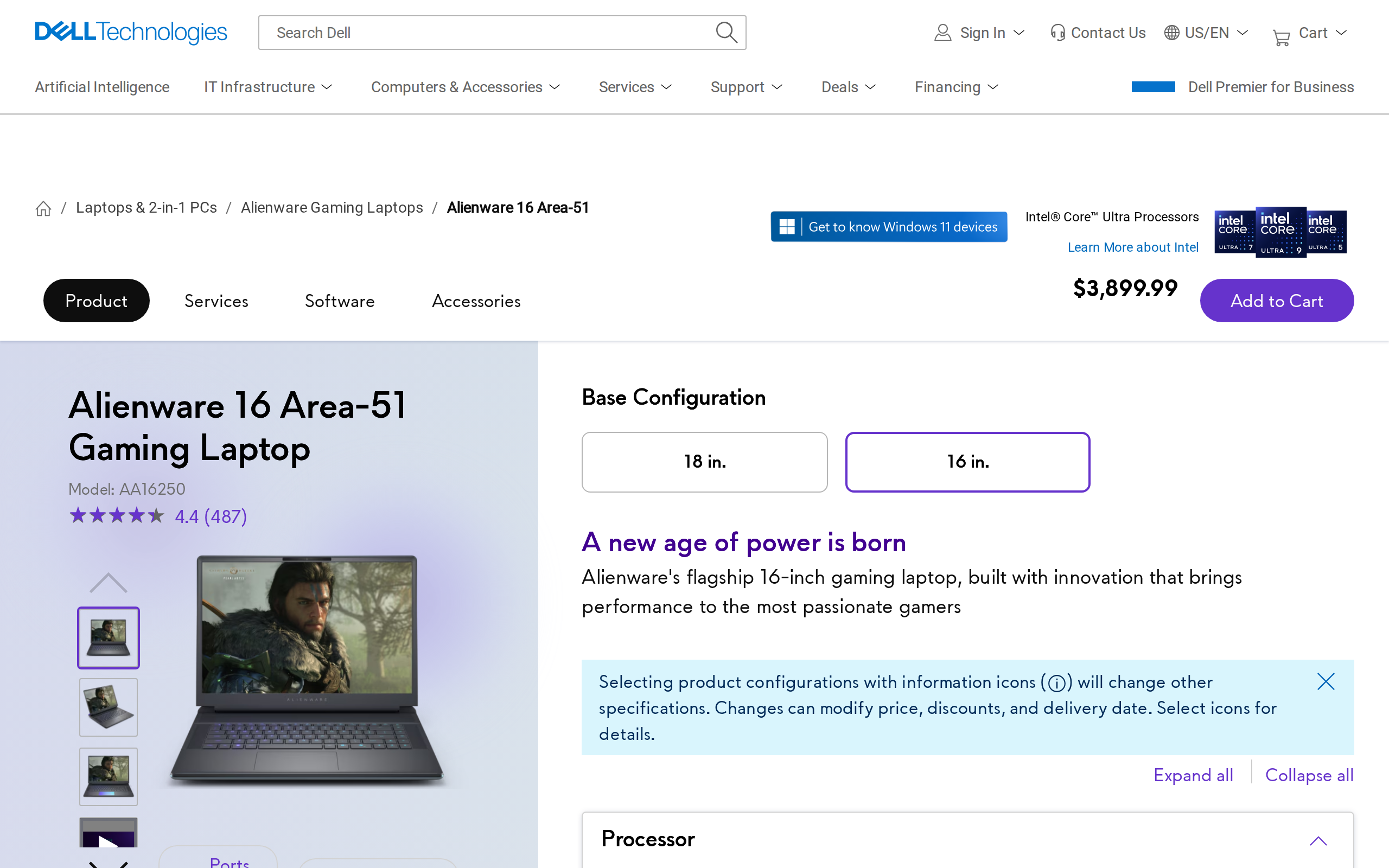
Our brief lists the laptop from $1,949.99. The page we captured told a different story: the default configuration showed $3,899.99, with GPU choices from RTX 5060 to RTX 5090 listed as upgrades or discounts against that base. Laptop Mag tested a $3,249 build with an RTX 5080, a Core Ultra 9 275HX, 32GB of RAM and 1TB of storage. Dell reprices these often, so the number you pay depends on the week and the configuration. Read the cart total, not the headline.
What the weight actually buys
Reviewers put the laptop at about 7.49 lb (Laptop Mag measured 7.13 lb), with a body up to 1.12 inches thick, plus a 360W power adapter that one review we read weighs at roughly 2.2 lb. Dell sells a 280W adapter as the standard one. That is the cost. The return is thermal room. Reviews found the RTX 5080 inside running at its full 175W, with 240W combined for CPU and GPU, and in 3DMark Time Spy it scored 20,960, second among RTX 5080 laptops behind the HP Omen Max 16.
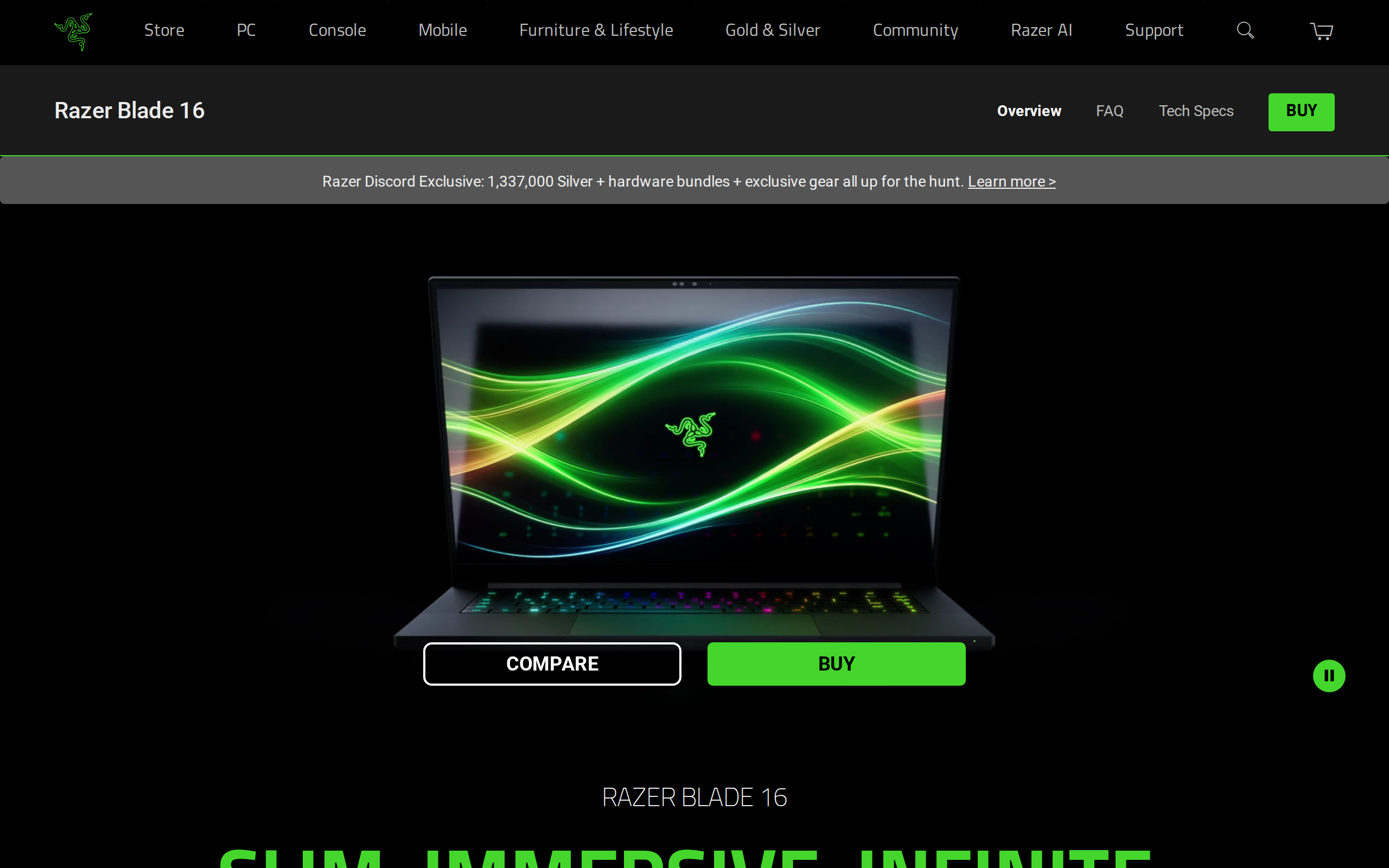
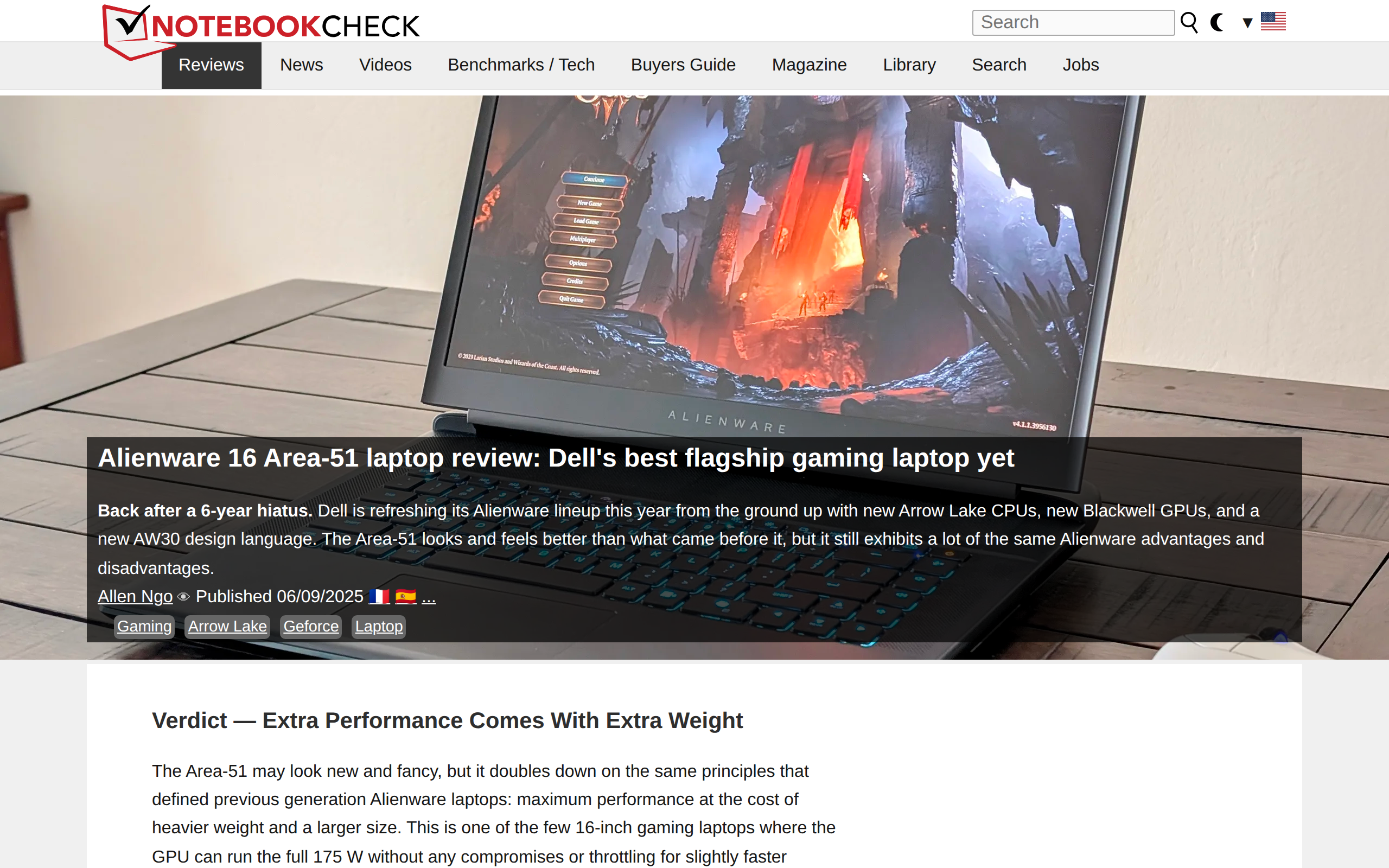
Notebookcheck went further in a separate piece, arguing that the 5080 Area-51 can sometimes beat a Razer Blade 16 carrying an RTX 5090. We could not open that article in full, so treat it as a headline claim. It does fit what we know about sustained power.
The numbers from the one test we could read
Laptop Mag's 1080p results on its RTX 5080 unit: Assassin's Creed Mirage at 149 fps, Far Cry 6 at 121, Red Dead Redemption II at 117, Cyberpunk 2077 at about 63 and Black Myth: Wukong at 58. Those last two are the demanding titles, and they show where a laptop RTX 5080 starts to strain at 1080p.
Where the bulk shows up
Under gaming load the same test measured the chassis at 118.7 degrees F, above the comfort line the reviewer uses, against 92.9 at idle. Battery life was 4 hours 10 minutes in general use and 1 hour 50 minutes gaming. Neither number is a surprise at this power. If you take it to a cafe, you need the brick.
Specs
- CPU options
- Intel Core Ultra HX series, up to Ultra 9 275HX or newer
- GPU options
- RTX 5060 up to RTX 5090 Laptop
- Tested GPU power
- RTX 5080 at 175W, 240W combined
- Display
- 16-inch QHD+ (WQXGA) 240Hz, OLED option on Dell's page
- Memory
- 16GB to 64GB DDR5 SODIMM, user-accessible
- Storage
- M.2 SSD slots, 1TB to 12TB configurations
- Battery
- 96Whr
- Power adapter
- 280W standard or 360W
- Weight
- About 7.49 lb (7.13 lb measured by Laptop Mag)
- Dimensions
- 14.37 x 11.41 x 0.85 to 1.12 in